
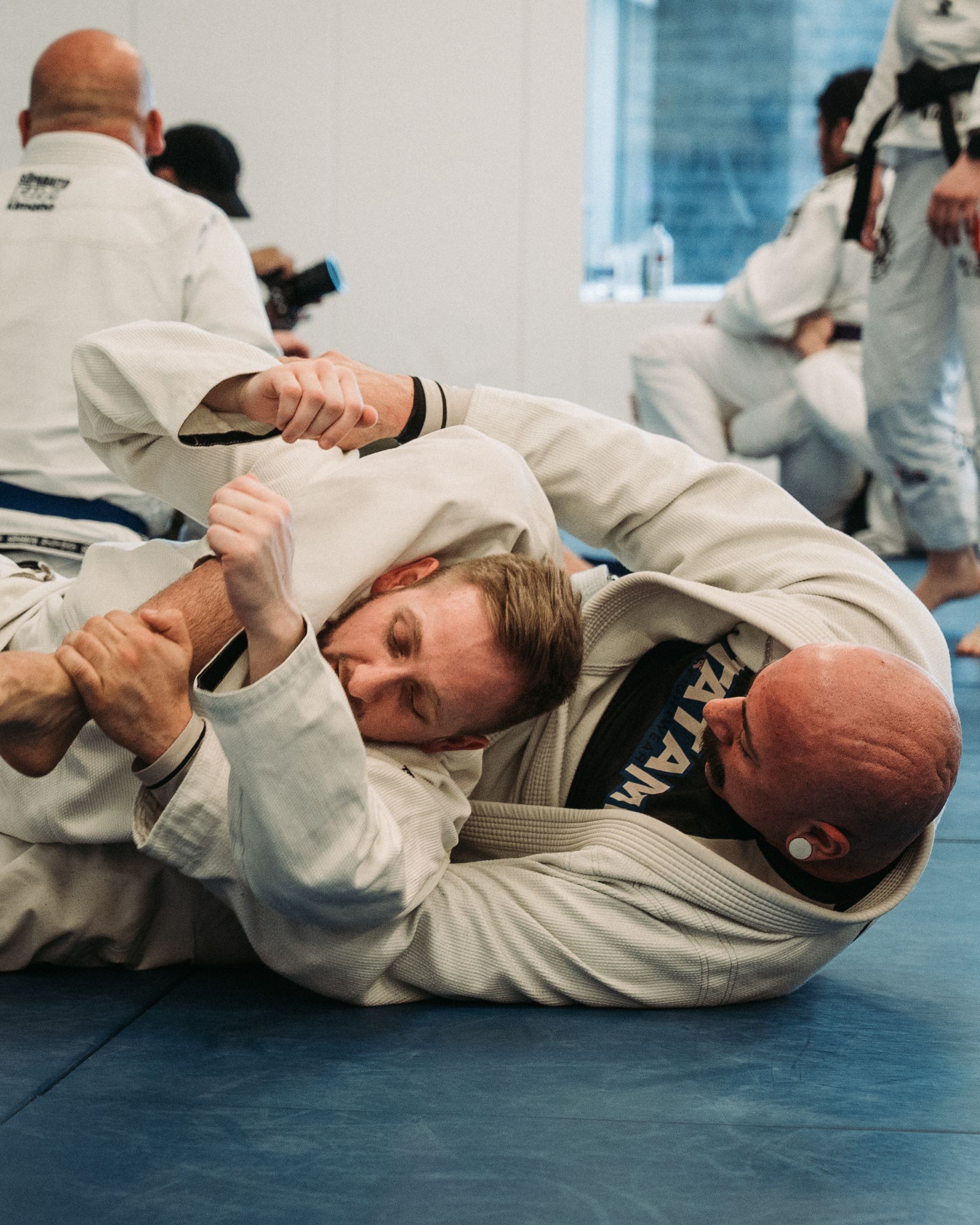
A few focused rounds of training can sharpen your mind as much as your technique.
Adult Jiu-Jitsu is growing fast, and the reason is simple: it fits real life. It is practical, mentally engaging, and challenging in a way that does not require you to be an elite athlete to start. With roughly 6 million practitioners worldwide and around 750,000 in the USA, more adults are choosing this path because it trains the body and the brain at the same time.
In our Adult Jiu-Jitsu program, we see how quickly training can affect everyday performance. You learn to solve problems under pressure, regulate your breathing, and stay present while your body works hard. Those are not abstract skills. You feel them when you walk back into work on Monday, handle a tough conversation, or simply focus better in the middle of a busy day.
If you are looking for Adult Jiu-Jitsu in Montgomery, NJ, the biggest shift is usually not physical at first. It is mental. Adults often tell us the training gives them a kind of clarity, a quieter mind, and a reliable way to build resilience without needing a perfect schedule or a perfect starting point.
Why Adult Jiu-Jitsu feels different for your brain
Jiu-Jitsu is a thinking person’s martial art. When you train, you are not just repeating moves. You are making decisions: where your weight is, what grips matter, how to create space, when to stay tight, and when to move. That constant problem-solving trains focus in a very direct way.
A study of adult participants found that 75% reported improved concentration, 87.6% reported improved confidence, and 87.5% reported reduced anxiety. That lines up with what we notice in class: once you have a clear task and a resisting partner, distractions tend to fade. You cannot scroll your way out of a bad position. You have to be here, now.
In Adult Jiu-Jitsu, focus is not a personality trait you either have or do not have. It is a skill you practice. Over time, you start recognizing patterns faster, staying calmer longer, and recovering from mistakes without spiraling. That is resilience in action, built one round at a time.
Focus is trained through constraints, not motivation
Most adults do not need another lecture about discipline. You already know how to show up for responsibilities. The trick is finding something that reliably pulls your attention into the moment. Jiu-Jitsu does that because the constraints are real and immediate: your partner is moving, your balance is changing, your timing matters.
In our Adult Jiu-Jitsu classes, we structure training so your focus develops progressively. You start with a specific goal for a round, like maintaining posture in someone’s closed guard or escaping side control using a simple sequence. By narrowing the task, you get repetition without mindless drilling.
Then we add small layers: a different grip, a different reaction, a slightly different entry. Your mind stays engaged because the puzzle evolves. And because the training is live and cooperative, you learn to focus without panic. That matters, especially if you spend your days switching between meetings, family demands, and a million small interruptions.
Resilience comes from learning to lose safely
One reason Adult Jiu-Jitsu builds resilience is that it normalizes discomfort in a controlled environment. You will end up in tough spots. You will tap. You will get stuck. That is not a sign you are failing. It is the training.
We keep the culture respectful and structured so you can learn without feeling like you have to prove anything. The goal is not to “win practice.” The goal is to improve your decision-making and your composure. When you get used to resetting after a tough round, you start doing the same thing off the mats: reset, learn, try again.
Research also shows that 96.9% of adult participants experienced life skill transference from training. That makes sense. Resilience is not just grit. It is the ability to stay adaptive, keep perspective, and respond instead of react. Jiu-Jitsu gives you a place to rehearse those skills with real feedback.
Jiu-Jitsu in Montgomery, NJ for busy adults: how training fits real schedules
A common worry is time. Adults are juggling work, commuting, family, and everything else that piles up. The good news is that consistent progress does not require living at the academy. The average training time is about 6 hours per week, which often looks like two or three classes plus a bit of open mat or a short extra session when life allows.
Our class schedule is designed to be realistic for Montgomery-area professionals and parents. You can train before the day gets away from you, after work, or on a weekend window. We also help you choose a pace that supports recovery, because training hard is only useful if you can keep doing it.
When you train Adult Jiu-Jitsu consistently, your week gets anchored by something steady. That is part of the appeal. You know you will show up, move your body, learn something, and leave with a clearer head.
What you will practice in Adult Jiu-Jitsu (and why it improves focus)
Most people think of Jiu-Jitsu as a collection of submissions, and sure, those are part of it. But the deeper benefit comes from the positions and transitions that force you to pay attention to details. You learn where control comes from, how leverage beats strength, and how timing can change everything.
Here are a few areas we emphasize in our Adult Jiu-Jitsu program:
• Positional control and escapes that teach you to stay calm and methodical under pressure
• Guard passing fundamentals that develop patience, timing, and problem-solving
• Submissions as a finish, not a shortcut, so you build awareness and safe mechanics
• Defensive frames and posture that improve body control and reduce frantic movement
• Live rounds with clear training goals, because focus improves when the objective is specific
This structure matters because adults learn best when the purpose is clear. When you understand why a detail matters, you retain it longer. That is adult learning theory in practice, and it is also one of the reasons a structured curriculum can help reduce injury risk.
Gi and No-Gi: two formats, one goal
We offer training in both Gi and No-Gi formats because each teaches something valuable. The Gi slows certain exchanges down and highlights grip fighting, posture, and precise control. No-Gi often speeds up transitions and emphasizes movement, pressure, and connection without cloth grips.
For your focus and resilience, both are useful. The Gi rewards patience and micro-adjustments. No-Gi rewards quick decision-making and adaptability. Switching between them helps you become more flexible mentally, which is exactly what many adults are looking for when they search for Jiu-Jitsu in Montgomery, NJ.
If you are brand new, we guide you into both formats at a pace that makes sense. You do not need to pick an identity on day one. You just need a starting point and a plan.
Safety and longevity: training hard without training reckless
Safety is not just about avoiding injuries. It is about training in a way that you can sustain for years. Data suggests that about 69.1% of respondents reported not sustaining a serious injury on the mats, and BJJ shows a lower injury rate per 1,000 athlete exposures compared to sports like Judo, MMA, Taekwondo, and wrestling.
In our Adult Jiu-Jitsu classes, we take that seriously. We coach tapping early, maintaining control, and choosing training intensity that matches experience level. We also teach you how to move with awareness, not force. Adults often surprise themselves here: once technique clicks, training actually feels smoother and safer.
We also believe curriculum matters. A structured approach that respects adult learning helps you progress without constantly jumping into high-risk chaos. You still get challenging rounds. You just get them with guardrails.
The community effect: why adults keep showing up
People often start Adult Jiu-Jitsu for fitness, stress relief, or self-defense. Many stay because of community. In one study, adult practitioners reported a 100% sense of community. That sounds dramatic until you experience the simple reality of training: you cannot improve alone. You learn with partners, and the room gets better together.
Our environment is built around mutual respect and consistency. You will work with a mix of experience levels, body types, and backgrounds, and you will learn how to be a good training partner while still pushing yourself. That combination is rare in adult life. Most places you go, you either compete or you socialize. Here, you do both in a constructive way.
And there is a quiet benefit: you get a structured social environment that supports commitment. When training is on your calendar and people expect to see you, it gets easier to keep your promises to yourself.
How adults typically progress in the first 90 days
Beginners often want to know what “good progress” looks like. In reality, your first wins are simple: breathing better in bad positions, recognizing common setups, and feeling less overwhelmed. The techniques stack faster than you think, but the confidence shift is usually the first thing you notice.
A practical way to think about your first months in Adult Jiu-Jitsu is in phases:
1. Weeks 1 to 3: Learn the room, basic positions, and the tap culture so you feel safe and oriented
2. Weeks 4 to 6: Build a few reliable escapes and one or two attacks so rolling feels less random
3. Weeks 7 to 10: Start connecting techniques into sequences and recognize patterns more quickly
4. Weeks 11 to 13: Improve pacing, recover faster between rounds, and begin training with intention
This is also where focus shows up in daily life. Once you are used to staying present during hard rounds, normal stress feels a bit more manageable. Not perfect, but different.
Membership, consistency, and building a training rhythm you can sustain
Adults succeed in Jiu-Jitsu when training becomes part of a realistic routine. We help you choose a frequency that supports your goals, whether you want steady skill development, better fitness, or a healthy outlet for stress.
If your schedule is unpredictable, we encourage you to think in weekly targets instead of daily perfection. Two solid sessions every week can change your baseline. Add a third when you can, and progress tends to accelerate. We also suggest tracking one simple focus goal for each class, like maintaining posture, finishing an escape, or staying relaxed in transitions. Small targets create big momentum.
We also know the mental side matters. Showing up after a long day takes energy. But many adults find that training restores energy, because it clears the mental clutter. You leave tired, sure, but it is the good kind of tired.
Take the Next Step
If you want a practical way to build focus, resilience, and confidence, our Adult Jiu-Jitsu program is designed to meet you where you are and help you grow from there. Training is challenging, but it is also structured, safe, and surprisingly energizing once you get your footing.
When you are ready to experience Adult Jiu-Jitsu in Montgomery, NJ with a clear curriculum and a supportive room, we would love to help you get started at Montgomery Brazilian Jiu-Jitsu and make training a steady part of your life.
Continue your Brazilian Jiu-Jitsu journey beyond this article by joining a class at Montgomery Brazilian Jiu-Jitsu.