
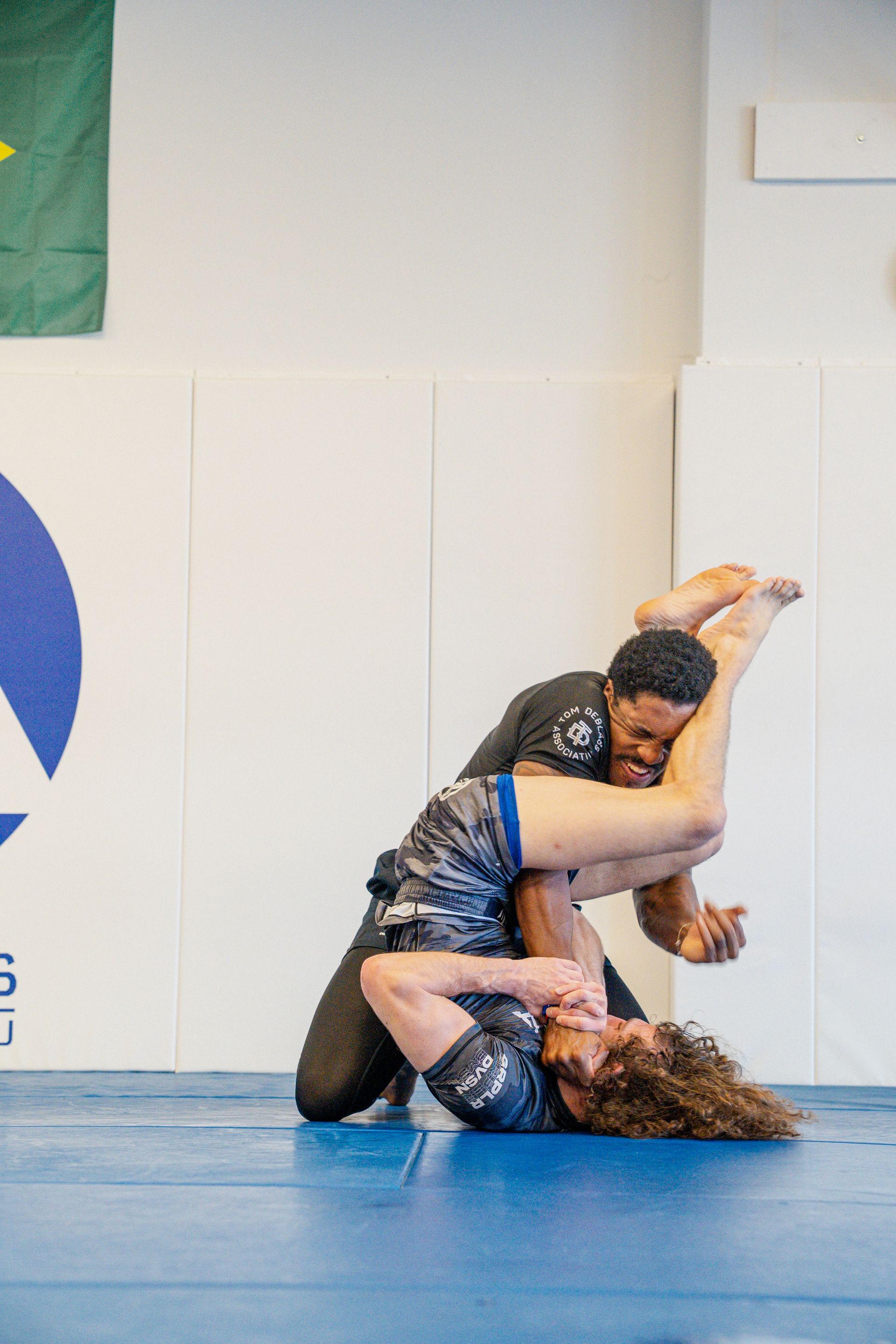
Jiu-jitsu gives you a way to handle pressure calmly, solve problems faster, and feel more capable in everyday life.
Most adults start training because they want something practical: better fitness, real self-defense skills, or a healthier way to handle stress. What surprises many people is how quickly Jiu-jitsu starts showing up outside the gym. The lessons are physical, sure, but they are also mental and strangely relatable to work, family, and daily routines.
In our adult program, we see the same pattern over and over: you come in to learn how to move and defend yourself, and you end up learning how to think differently under pressure. You start noticing better posture in meetings, calmer breathing in traffic, and a little more patience when the day gets chaotic.
This is exactly why adult Jiu-jitsu in Montgomery, NJ keeps growing. It fits real adult life. You can train twice a week, make steady progress, and get benefits that go far beyond a workout.
Why Jiu-jitsu clicks for adult life in Montgomery, NJ
Life here moves quickly. Many adults juggle demanding jobs, long commutes, parenting schedules, and a constant stream of responsibilities that do not pause just because you are tired. Training gives you a place where the rules are clear, the feedback is immediate, and your progress is measurable. That structure matters.
Jiu-jitsu in Montgomery, NJ also appeals to adults because it scales. You do not need to be fast, young, or naturally athletic to start. We coach you to use leverage, positioning, and timing, so the art stays accessible even if you are coming in with old sports injuries or a desk-job body that has not sprinted in a while.
And there is a social element adults often do not realize they are missing. A consistent training group becomes a community without forced small talk. You drill together, you learn each other’s styles, and you build trust through shared effort.
The biggest real-life lessons you learn on the mat
1. Staying calm when you are uncomfortable
Rolling can feel intense at first. Your heart rate rises, your brain tries to rush explained decisions, and you discover how easy it is to waste energy when you panic. Over time, we teach you to slow down, breathe, and keep making good choices even when you are tired or pinned.
That skill transfers cleanly into adult life. You start noticing that discomfort is not automatically danger. It is often just a moment that needs patience. At work, that can look like responding thoughtfully instead of reactively. At home, it can look like pausing before you snap at someone you love.
A lot of modern stress is not physical, but your nervous system reacts like it is. Training gives you a safe place to practice regulating that response.
2. Problem-solving instead of forcing outcomes
People call Jiu-jitsu “human chess” for a reason. You are constantly making small decisions about angles, grips, base, and timing. When something fails, you adjust. When something works, you learn why.
This is one of the most practical mental models adults can build: stop trying to muscle through problems and start looking for better positions. You begin thinking in steps. Get safe, improve position, then work toward your goal. That is a good approach for difficult conversations, project management, and even personal habits.
We also emphasize that there is rarely a single perfect answer. There are options. Learning to choose an option calmly is a life skill.
3. Real confidence, not hype
There is a confidence that comes from pep talks, and there is confidence that comes from evidence. Training builds the second kind.
Recent survey-based findings line up with what we see: a large majority of Brazilian Jiu-jitsu practitioners report increased confidence, with one 2024 study noting 87.6 confidence improvements among BJJ trainees. That matters because it suggests this is not just a vibe, it is a repeatable outcome of consistent practice.
Your confidence changes because you test your skills against resistance. You learn what you can handle. You also learn what you still need to work on, which keeps your ego in check in a healthy way.
4. Resilience you can feel, week after week
Resilience is not an abstract concept on the mat. It is getting caught, tapping, resetting, and trying again. It is showing up when you are tired and still doing the work.
A 2024 study reported 92 resilience gains among martial arts trainees training twice weekly. That is a strong hint that the schedule most busy adults can realistically maintain still produces meaningful psychological benefits.
We see this in our members who start by “just trying it” and then realize they are handling life stress differently. You do not become unbreakable. You become more adaptable, which is the real win.
How training helps with stress and mental health without feeling like therapy
Training is physical, but it also changes how your brain processes stress. During sparring, you focus on immediate tasks: posture, frames, breathing, movement. That focus can create a flow state where the usual mental noise quiets down. You leave class tired in a good way, like your brain finally got permission to stop spinning.
There is also the endorphin effect. A challenging full-body workout can reduce stress and improve mood, and Jiu-jitsu tends to do this more naturally than repetitive routines because it requires attention, variation, and engagement.
Long-term, research trends from 2023 and 2024 link sustained training with improved mental strength, resilience, grit, self-efficacy, and self-control. The differences become even more noticeable with experience, with advanced belts showing stronger profiles than beginners in measures like life satisfaction and grit. In plain language: consistency changes you, and you can measure it.
The physical benefits adults actually care about
You do not need a lecture on fitness to know you should move more. What adults want is training that feels useful, not random. Jiu-jitsu delivers a full-body workout through pushing, pulling, bridging, rotating, and stabilizing under load.
Over time, our adults tend to notice:
- Better cardiovascular health from rounds that spike your heart rate in short bursts
- Functional strength from controlling posture, grips, and balance
- Improved flexibility and joint mobility from moving through varied positions
- Increased coordination from timing-based drills and transitions
- Better endurance because you learn to conserve energy and breathe efficiently
It is also easier to stick with because it stays interesting. You are not just counting reps. You are learning skills.
What a typical adult class looks like in our program
Adults often worry that class will be intimidating or chaotic. In practice, we keep it structured and progressive so you can learn safely.
Most classes follow a simple arc:
1. Warm-up focused on movement patterns you will actually use
2. Technique instruction with clear details and troubleshooting
3. Partner drilling at a controlled pace
4. Live rounds that scale to your experience level, with safety and tapping emphasized
5. Quick wrap-up so you leave with a specific takeaway
You will not be thrown into the deep end on day one. We build your base first, then add layers. That approach is especially important for adult beginners who want to train hard without feeling broken afterward.
Beginner concerns we hear all the time, answered honestly
Is this safe for adult beginners?
Yes, when taught progressively and practiced with good partners. We coach control, tapping, and communication. You can train intensely without training recklessly. If you have past injuries, we help you modify positions and choose smarter training intensity.
Do I need to be in shape first?
No. Getting in shape is one of the results, not a prerequisite. Technique matters more than raw strength, and your conditioning improves naturally as you train.
How often do I need to train?
Two classes per week is a realistic starting point for busy adults, and research suggests that frequency is enough to drive resilience gains for most trainees. If you train more, you progress faster, but consistency matters more than perfection.
What should I bring?
Comfortable training gear, a water bottle, and a willingness to learn. If you are not sure what to wear for your first class, we can guide you before you arrive.
Practical lessons you can apply immediately off the mat
This is where the “mat to real life” idea becomes more than a slogan. We see adults apply these lessons quickly, sometimes within the first month.
Here are a few real-world translations that tend to land:
- When you feel overwhelmed, focus on one small action that improves your position, then reassess
- When someone pressures you, keep your posture and your breathing steady before you respond
- When you fail at something, treat it like a tap: reset, learn, and try again without drama
- When progress feels slow, remember that skill compounds quietly through repetition
- When you feel stuck, ask better questions instead of forcing harder effort
These ideas sound simple, but training makes them automatic. You practice them with your body first, and then your mind starts using the same pattern elsewhere.
Why adults in Montgomery keep coming back to the mat
Adults stay for different reasons. Some love the self-defense aspect. Some want a challenging workout that does not feel boring. Some want a community that feels genuine. Many want all three, even if they would not say it that way out loud.
We also notice something subtle: training gives adults permission to be beginners again. That is rare. Your work life often expects competence all the time. On the mat, you are allowed to learn openly, ask questions, and improve step by step. That process builds humility and momentum, which is a strong combination for real life.
Take the Next Step
Building a more capable body and a steadier mind is not about a single breakthrough class. It is about showing up, learning progressively, and letting the lessons stack up in a way you can actually use. That is what we aim for every day, from fundamentals to advanced training.
If you are ready to experience adult Jiu-jitsu in Montgomery, NJ with a supportive structure and real-world focus, we would love to help you get started at Montgomery Brazilian Jiu-Jitsu and see what changes after a few weeks of consistent training.
Take what you learned here to the mat by joining a Jiu-Jitsu class at Montgomery Brazilian Jiu-Jitsu.