
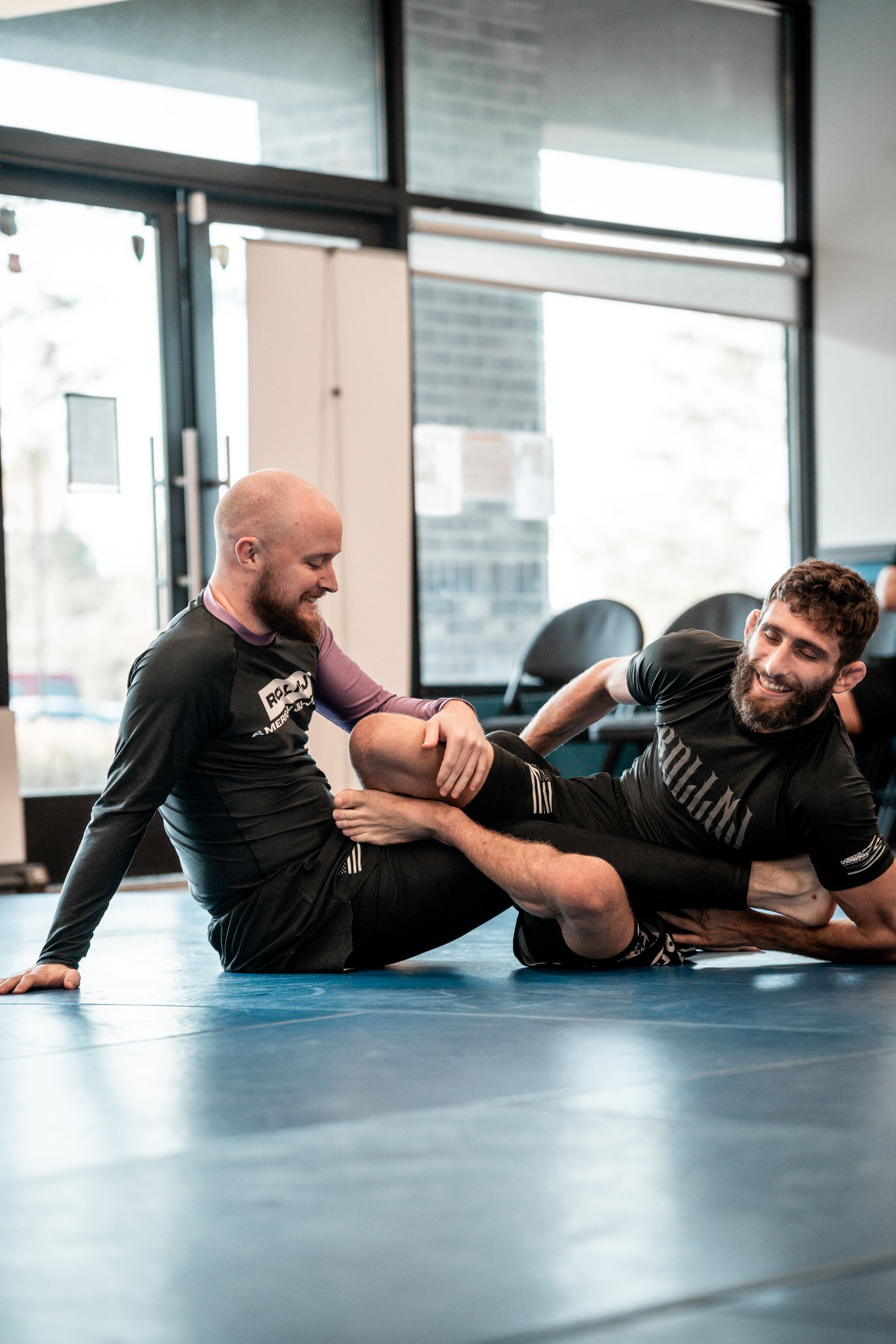
Adult Jiu-Jitsu turns “I should get out more” into a weekly routine where familiar faces quickly become real training partners.
Making friends as an adult is oddly hard, even when you genuinely want to. Schedules are packed, social events are hit-or-miss, and “we should hang out sometime” doesn’t always turn into anything consistent. Adult Jiu-Jitsu solves a big part of that problem in a surprisingly practical way: you show up, you train, and you see the same people often enough that connection has room to grow.
In our Adult Jiu-Jitsu program, you do not just exercise near other people. You work with them. You rotate partners, troubleshoot techniques together, and learn how to be calm while you are tired and figuring things out. Over time, that mix of shared challenge and mutual support becomes something adults in Montgomery, NJ often say they have been missing: a dependable community.
This matters locally, too. When your training is close to home, it is easier to stay consistent, and consistency is the secret ingredient for both progress and friendships. If you have been searching for Adult Jiu-Jitsu in Montgomery, NJ because you want skills, fitness, and a place you actually look forward to going, you are in the right lane.
Why Adult Jiu-Jitsu creates connection faster than most adult hobbies
Adult Jiu-Jitsu has a built-in social structure. You do not have to be an extrovert, and you do not have to “network.” You simply participate, and the format does the heavy lifting.
You train with people, not around people
Most adult fitness options are parallel play: you lift, you run, you go home. In Jiu-Jitsu, partner work is the point. In a typical class, you drill a technique with one partner, then switch. You ask a quick question, you laugh at the weird detail you keep forgetting, and you try again. That repeated, low-pressure interaction is exactly how people become familiar.
Because we rotate partners, you are not locked into one person or one clique. You get to know different personalities, body types, experience levels, and styles. Over time, you start recognizing who gives helpful feedback, who moves smoothly, who cracks a quiet joke during drills, and who always remembers to check that you are okay before turning up the pace.
Shared difficulty turns strangers into teammates
BJJ is challenging in a very specific way. You will get tired, you will get stuck, and you will have moments where you feel like you are “thinking in slow motion.” That is normal, and it is also a bonding experience.
There is something quietly powerful about working through a hard round, slapping hands at the end, and knowing you both helped each other get better. Research on Brazilian Jiu-Jitsu communities consistently highlights friendship and social support as common reasons people keep training, including a 2025 qualitative study that identified community relationships and friendship among major themes for women who continued participating. We take that seriously, because the room’s culture is not an accident.
The relationship is reciprocal by design
Adult Jiu-Jitsu is not only about what you get. It is also about what you give. In drilling, one person practices while the other provides the right amount of resistance, then you switch. In sparring, you learn to be a good partner, not just a tough one.
That reciprocity builds trust. You start noticing the small, human things: someone letting you reset when your sleeve is tangled, someone reminding you to breathe when you tense up, someone showing you a detail after class because you looked frustrated. Those little moments add up.
The “friendship funnel” we see on the mat
Friendship in Adult Jiu-Jitsu usually follows a pattern. It is not forced, and it does not happen overnight, but it is surprisingly reliable if you keep showing up.
1. Stranger phase: You are new, learning names, and mostly focused on not doing something wrong.
2. Familiar face phase: You recognize people, you start greeting each other, and you have a couple go-to partners.
3. Training partner phase: You develop trust, pace awareness, and the ability to help each other improve.
4. Community phase: You have inside jokes, shared milestones, and people notice when you miss a week.
None of that requires being “the social one.” It requires attendance. If you come twice a week for a month, you have already spent more time with the same group than you would at most adult social events.
Adult Jiu-Jitsu in Montgomery, NJ for beginners: what your first 90 days can look like
New students often want a realistic timeline, not hype. Here is what we commonly see when adults start training consistently.
Weeks 1 to 4: learning the room and the basics
You learn how class flows, what the warm-up feels like, how to move safely on the mat, and how tapping works. You start building a base of fundamentals: posture, frames, grips, escapes, and basic positions. Socially, you start recognizing the regulars, and people start recognizing you, which matters more than it sounds.
Weeks 5 to 8: things begin to “click” (a little)
You still feel new, but you begin to connect techniques to positions. You might notice that you can survive a bit longer in sparring or escape a position that used to feel hopeless. This is also when you often find a couple training partners who match your pace well. That is where friendship usually starts to feel real, because you trust each other with intensity and safety.
Weeks 9 to 12: confidence and belonging show up
You are not an expert, but you are part of the room. You know where to stand, you know the names you used to forget, and you can help a newer person with something simple, like how to shrimp or where to line up. Those moments build identity. Research on BJJ participation suggests that people who feel more integrated into their peer group tend to identify more strongly with the club and keep participating, and our experience matches that: belonging supports consistency.
More than friends: what adults often gain alongside community
Most people start Adult Jiu-Jitsu for one reason, then stay for a few more. Sometimes it is fitness, sometimes it is stress relief, sometimes it is self-defense. Often it becomes a mix.
Fitness that does not feel like a lonely grind
BJJ builds conditioning, strength endurance, and mobility, but it rarely feels like mindless reps. You are solving movement problems with another person, which keeps your attention engaged. For busy adults, that can be a game-changer.
Stress relief through focused effort
You cannot multitask during sparring. Your mind has to be present. Many students report that class helps them decompress because it forces a kind of mental reset. Emerging research links longer BJJ experience with traits like resilience, self-efficacy, self-control, life satisfaction, and mental strength, but those are associations, not promises. Your results depend on your training environment, your recovery, and what else is going on in life. Our goal is to make the room a place where you can work hard and leave feeling better, not more worn down.
Self-defense confidence without needing to be “a fighter”
Adult Jiu-Jitsu teaches you how to control distance, position, and leverage, especially in close-contact situations. For many adults, the real value is not a fantasy of winning every scenario. It is the calmer feeling of understanding what to do, what to avoid, and how to stay composed.
The social environment is not automatic, so we treat it like part of the program
BJJ culture can be excellent, but it does not run on autopilot. Studies emphasize that coaches and peers strongly influence whether a club feels supportive and worth continuing. We agree, and we act like it.
Here are a few ways we help Adult Jiu-Jitsu feel approachable and inclusive from day one:
• We explain basic etiquette early so you do not feel lost, including tapping, pacing, and partner expectations.
• We rotate partners with intention so beginners are not left alone or stuck with someone moving too fast.
• We coach intensity so sparring stays controlled and technical, especially for newer students.
• We encourage questions, because confusion is normal and silence slows learning.
• We keep the tone respectful, because trust is what makes hard training possible.
If you are a woman starting BJJ, or you are returning to training after years away, or you are simply nervous, we take that seriously. The goal is not to “tough it out.” The goal is to learn safely, steadily, and with the support of a room that wants you to come back.
Practical questions adults in Montgomery ask before starting
Do I need to be fit before starting Adult Jiu-Jitsu?
No. You can start at your current fitness level. We can scale rounds by pace, rest, and partner selection. It will still be challenging, but you build conditioning gradually, and consistency matters more than trying to be in perfect shape on day one.
Do I have to compete?
No. Competition is an option, not a requirement. Many adults train for fitness, stress relief, self-defense, personal growth, or community. If you want to compete, we can guide you. If you do not, you are still training “for real.”
Will I get injured?
BJJ involves contact and carries injury risk, like most sports. We reduce risk through coaching, controlled intensity, clear tapping rules, warm-ups, and hygiene expectations. You should tell us about injuries or limitations, and you should consult a medical professional when appropriate.
What should I wear to my first class?
Ask us what we prefer for your first class, since attire can vary by class type. In general, clean athletic clothing without zippers, buttons, or hard parts is a safe starting point, and we will help you from there.
How often should I train?
A realistic starting point is one or two classes per week. You can always add more later. Starting with a schedule you can keep is better than going hard for two weeks and disappearing.
Adult Jiu-Jitsu in Montgomery, NJ works best when it is close and consistent
One of the underrated benefits of training locally is how it supports follow-through. When your academy is nearby, you are less likely to skip because of traffic, weather, or a long commute after work. And because the people you meet also live and work nearby, friendships are easier to maintain. You are not building a social circle across three towns. You are building it right where you already live.
That local consistency also changes the vibe. You start seeing the same people week after week. You notice progress. You celebrate small wins. You get the “good to see you” nod when you walk in, even after a rough day. That is community, in a very real, very adult way.
Take the Next Step
If you want a hobby that gives you fitness, practical skills, and a real shot at lasting friendships, our Adult Jiu-Jitsu program is designed to make showing up feel doable and worthwhile. The mats create repeated contact, shared challenges, and a culture of respect, and that combination tends to turn casual acquaintances into dependable training partners over time.
When you are ready to experience it in person, we would love to welcome you at Montgomery Brazilian Jiu-Jitsu in Montgomery, NJ, help you get oriented, and make your first few weeks feel clear instead of overwhelming.
Put the techniques you read about into practice on the mats at Montgomery Brazilian Jiu-Jitsu.