
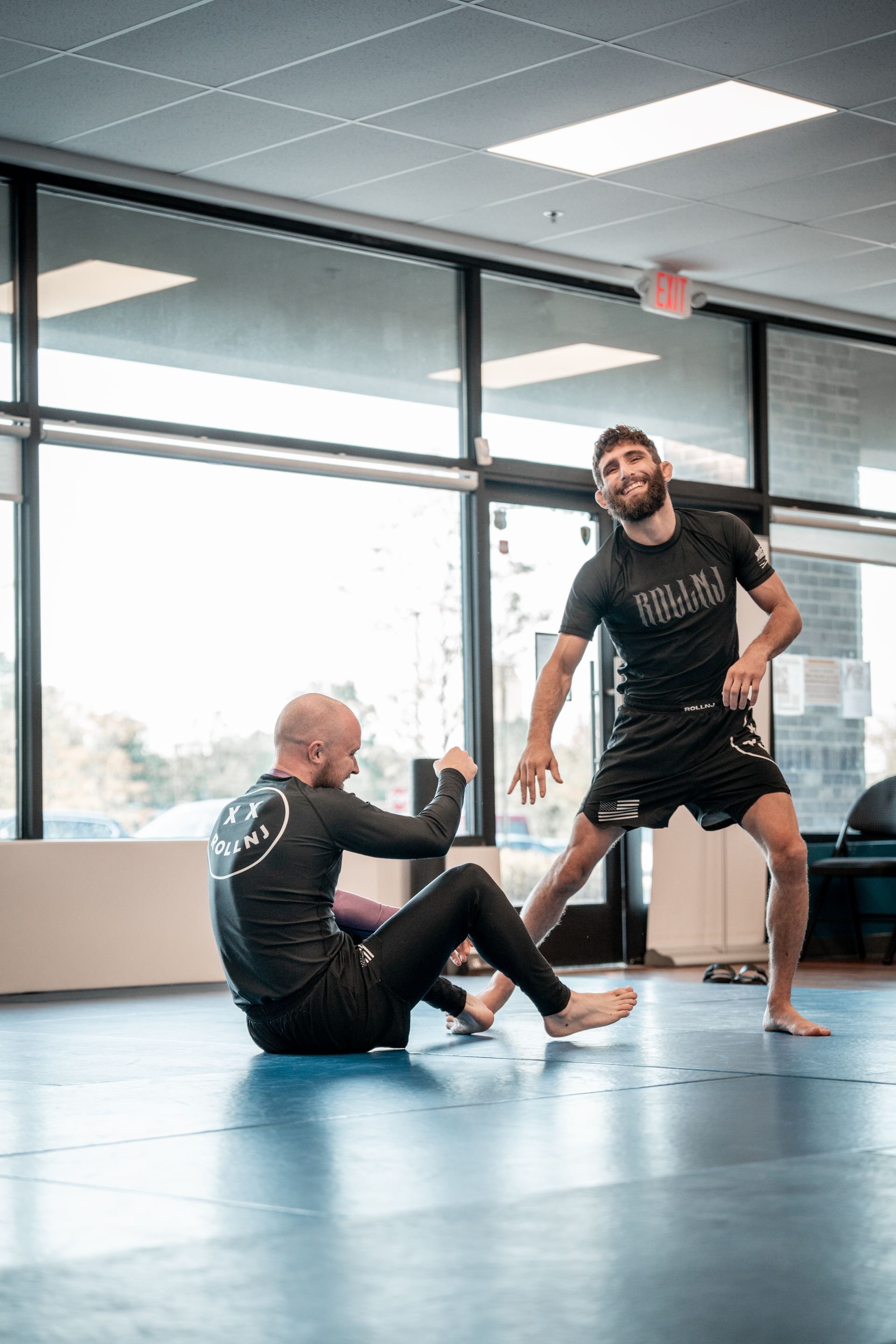
The fastest progress in Jiu-jitsu usually comes from drilling the basics the same way, every time, until your body stops “thinking” and starts moving.
If you want to get better at Jiu-jitsu quickly, your first win is building a reliable foundation you can repeat under pressure. Most adults do not need more techniques, more highlight clips, or more complicated answers. You need a small set of fundamentals that show up in every roll, then a clear way to practice them until they feel automatic.
In our adult program, we see the same pattern over and over: students who improve fastest are not the ones who “know” the most moves. They are the ones who can move well on the ground, keep safe positions, and escape bad spots without panicking. That is what drilling is for.
This guide breaks down the proven drills we use to help you master the essentials faster, especially if you are training Jiu-jitsu in Montgomery, NJ and balancing work, family, and a schedule that is already full.
Why fundamentals make progress feel faster
Fundamentals are not the “beginner” part you graduate from. They are the part you keep sharpening because they decide almost everything that happens in training. If you can hip escape cleanly, frame properly, and recover guard when you are tired, your whole game levels up without adding anything flashy.
The core positions matter most because they are where you spend time: closed guard and open guard, side control, mount, and back control. From those positions, you either protect yourself, improve position, or finish. The same is true for core movements like shrimping, bridging, forward and backward rolling, and technical stand-ups. We treat these like the alphabet of grappling. Once you are fluent, learning “words” and “sentences” gets easier.
A helpful mindset shift is defense first. When you train to become hard to submit, you relax more, breathe better, and you stop giving away easy openings. Oddly enough, that makes your offense improve too, because you can actually build attacks from stable positions instead of scrambling.
The drill framework we use for faster mastery
Drilling is not just “reps.” The best drilling has a purpose and a feedback loop. In class, we keep drills simple and measurable so you can feel progress week to week.
Here is the basic framework we use:
• Start with clean mechanics at low speed so you learn the shape of the movement
• Add light resistance so you learn timing and balance
• Add constraints, like a limited goal, so you learn decision-making
• Finish with positional sparring so you learn to apply the skill while breathing hard
This is also why drilling often beats full sparring early on. Sparring is valuable, but if your movement patterns are still messy, sparring can turn into survival mode. Drills let you learn safely and efficiently, then pressure-test at the right pace.
Proven solo drills you can do in 10 minutes
Solo training will not replace partner work, but it can dramatically speed up your progress if you keep it focused. If you can spare 10 minutes on a few days per week, you can sharpen the exact movements that show up in every round.
Drill 1: Hip escape and hip escape with re-guard
The hip escape, or shrimp, is one of the most important movements in Jiu-jitsu. It is how you create space from bottom positions and how you bring your knees back between you and your partner.
Steps:
1. Start on your back with knees bent and feet on the floor
2. Turn slightly onto your side and push off one foot
3. Slide your hips away while keeping your shoulders grounded
4. Bring your near-side knee in as if you are building guard
5. Reset and repeat, alternating sides
Tip: keep your elbows tight and imagine you are making room for your knee, not just scooting away. Clean reps beat fast reps.
Drill 2: Bridge and shoulder turn
Bridging is your engine for many escapes, especially from mount and side control. The goal is not “launching” your hips. The goal is lifting and turning enough to create an angle.
Steps:
1. Lie on your back with feet close to your hips
2. Drive through your heels and lift your hips
3. Turn to one shoulder as you bridge, as if you are tipping someone off balance
4. Return to center and repeat to the other shoulder
Tip: exhale on the effort. Holding your breath makes every escape feel harder than it needs to.
Drill 3: Technical stand-up
If you care about self-defense and practical control, the technical stand-up is a must. It teaches you to get up while staying protected.
Steps:
1. Sit up with one leg bent, one leg extended
2. Post your hand behind you for support
3. Lift your hips and pull your extended leg underneath you
4. Stand while keeping your free hand up as a frame
Tip: move smoothly, not dramatically. We want balance, not a big burst.
Drill 4: Forward roll and backward roll basics
Rolling teaches body awareness and helps you stay safe when you get bumped, swept, or off-balanced. It also builds confidence in transitions.
Key points:
- Tuck your chin so your head does not take impact
- Roll over your shoulder, not straight over your neck
- Keep your knees slightly bent so you can stand or face your partner quickly
If rolling feels awkward at first, that is normal. Most adults did not grow up doing this stuff on a mat, and it takes a little time.
Partner drills that build timing, leverage, and calm
Partner drills are where fundamentals start to feel like real grappling. We keep these drills anchored to positions you will hit constantly: guard engagement, passing, escapes, and back control.
The 6 drills we lean on for faster fundamentals
These are the drills that tend to produce the biggest “jump” in skill for adult students, because they connect movement to position and position to results.
• Over-under pummeling for inside control: Start on knees or standing, pummel for underhooks, then reset when you lose position; focus on posture and keeping your elbows connected to your ribs.
• Guard retention hip escape rounds: One partner circles to pass lightly while you use shrimping, framing, and knee recovery to keep guard; switch every 60 to 90 seconds.
• Elbow escape from mount: Start mounted, bottom partner bridges to force hands to post, then uses the elbow-knee connection to slide a knee in and recover half guard or full guard.
• Toreando pass footwork drill: From open guard, top partner practices controlling ankles or pant legs, stepping side-to-side, and landing in a stable side control angle without collapsing forward.
• Side control framing and re-guard: Bottom partner builds frames at the neck and hip, shrimps to create space, and inserts the near knee; top partner gives realistic pressure without “winning” the drill.
• Back control seatbelt to rear-naked choke pathway: Start with a seatbelt, practice staying tight through small movements, then finish the choke mechanics slowly and cleanly before resetting.
If you do these consistently, you will notice something important: you stop feeling “lost.” You begin recognizing where you are, what the goal is, and what the next step should be.
How to drill core positions the smart way
Positions are the container. Techniques are what you do inside the container. If the container is unstable, the technique falls apart. That is why we drill positional goals, not just submissions.
Mount: balance first, then isolate an arm
In mount, your first job is staying on top without being rolled. Drill keeping your knees heavy, your hips low, and your hands ready to post if your base gets challenged. Once you can hold mount comfortably, you can layer in attacks like the armbar or Americana.
A useful mount drill is “hold for 10 seconds, then advance.” You are not hunting a fast finish. You are proving you can stabilize, breathe, and keep control.
Side control: pressure plus a clear path to progress
Side control should feel like a place where you can rest while your partner works. That sounds rude, but it is actually a good benchmark. Drill crossface and hip control positioning, then drill transitions to mount or to the back when your partner turns.
We also teach you to avoid the common mistake of leaning too far forward. When your weight is in the wrong place, your partner recovers guard easily and you feel like you are chasing.
Guard: frames, angles, and the habit of getting your knees back in
Guard is where many beginners either get stuck or get overwhelmed. The shortcut is guard retention fundamentals: frames, hip movement, and knee recovery. If you can keep your knees between you and pressure, your guard starts working even before you know a bunch of sweeps.
From there, you can add classic attacks like triangle choke or armbars, but the guard itself must survive first.
Back control: stay connected
Back control is a finishing position, but it is also a control position. Drill staying glued to the hips, keeping your seatbelt tight, and following your partner’s attempts to slide down or turn in. If you lose the back because your hooks are loose, it does not matter how good your rear-naked choke is.
A simple 3-month fundamentals timeline for busy adults
For adult Jiu-jitsu in Montgomery, NJ, consistency usually beats intensity. We would rather see you train two to three times per week for months than go hard for two weeks and disappear for six.
Here is a realistic timeline we like because it is clear and attainable:
Month 1: Movement and survival
You focus on hip escapes, bridging, technical stand-ups, and learning to frame. You start recognizing mount, side control, and guard without freezing.
Month 2: Escapes and guard retention
You drill elbow escapes, side control escapes using frames and hip movement, and guard recovery. You begin lasting longer in positional rounds without burning out.
Month 3: Passing and first submissions
You start connecting passes like the toreando into stable side control, then build simple finishes like the Americana, kimura, armbar, triangle, and rear-naked choke with proper control.
If you show up consistently, your progress will feel less like a mystery and more like a system.
Common mistakes that slow your fundamentals down
Small errors compound fast in Jiu-jitsu. Fixing these early saves you months.
One big mistake is trying to win every round instead of winning the position. If you chase a submission from a shaky spot, you often end up underneath. Another is holding your breath. Breathing is a skill, and calm breathing makes everything more efficient.
Also, many adults train too tense. We want controlled intensity, but not stiffness. When you relax your shoulders and stop squeezing constantly, you move better and you last longer. It is not a personality trait. It is a learnable habit.
Finally, do not ignore the “boring” drills. Shrimping, bridging, and technical stand-ups look simple, but they show up everywhere. When those are sharp, your whole game feels sharper.
Take the Next Step
If your goal is to improve faster, the answer is not cramming more techniques into your week. The answer is drilling the same fundamentals with clear intent until your movement, escapes, and positional control feel dependable. That is exactly what we build into our classes, so you can walk in, train hard, and leave knowing what to practice next.
When you are ready to train with a structured approach in a welcoming environment, we would love to help you start at Montgomery Brazilian Jiu-Jitsu. You can use these drills right away, then let our coaches refine the details that make them work against real resistance.
Build stronger grappling skills and sharpen your technique by joining a Jiu-Jitsu program at Montgomery Brazilian Jiu-Jitsu.