
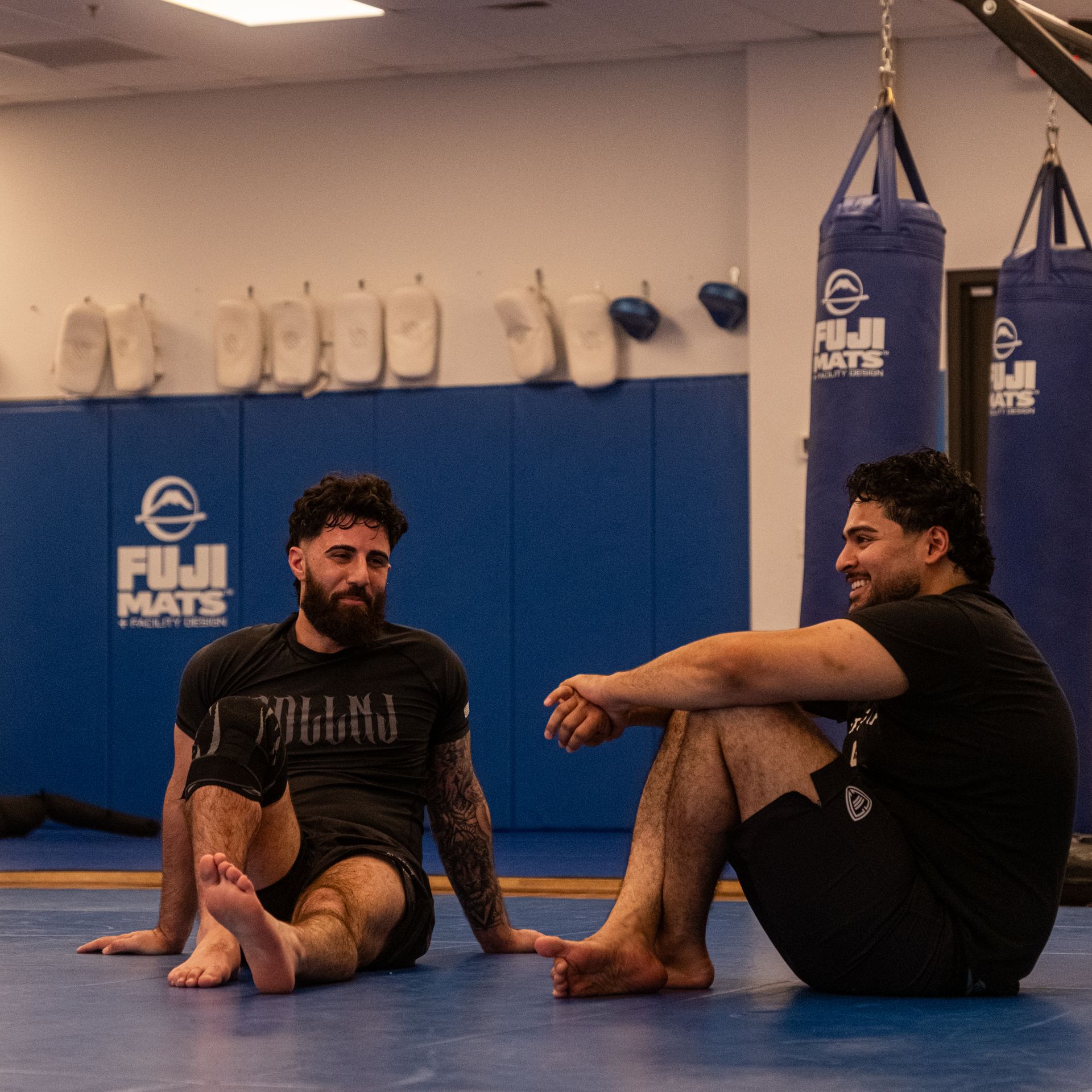
A few minutes on your living room floor can make your next class feel smoother, calmer, and more connected.
If you train Jiu-jitsu once or twice a week, you already know the feeling: class ends, you’re fired up, and then life happens. Work runs long, the commute piles up, kids need dinner, your body feels a little tight, and suddenly it’s been days since you moved like a grappler. That gap is where simple home drills shine.
We recommend home drilling because it builds the engine behind your techniques: hip mobility, framing habits, balance, and the ability to move without thinking so hard. In Jiu-jitsu, the difference between “I know this move” and “I can actually do it” is usually repetition, not another secret detail.
And the good news is you do not need a partner to get better at the fundamentals. Solo drills let you rehearse the exact motions you’ll use to escape pins, recover guard, stand up safely, and protect yourself during scrambles. When you show up to train, our goal is that your body already understands the language.
Why solo drills work for Jiu-jitsu (especially for busy adults in Montgomery)
Most adults in Montgomery are juggling full schedules, and that’s not changing anytime soon. The trend we’ve seen across the sport from 2023 to 2025 is simple: people still love in-person training, but home work has become a practical supplement. It’s the “in-between” training that keeps you progressing when you cannot make it to the mats every day.
Solo drills help because they improve:
• Mechanics: cleaner hip escapes, tighter rolls, safer posting and base
• Mobility: hips, spine, shoulders, ankles move more freely under pressure
• Conditioning: not just cardio, but grappling-specific endurance
• Confidence: you stop freezing because the movements feel familiar
• Injury resilience: controlled reps teach you how to move without panic
Just as important, drilling at home keeps your mind on Jiu-jitsu in a low-stress way. You are not trying to “win” a round in your living room. You are building movement quality.
Your at-home training rules: safe, consistent, and realistic
Before we get into the drills, we want you to train smart. Home sessions should leave you feeling better, not wrecked.
Warm up like you mean it (5 minutes)
A quick warm up matters more than people think, especially when you’ve been sitting at a desk. Keep it simple: neck circles, shoulder rolls, hip circles, deep squats with control, and a few easy bridges. If anything feels sharp or unstable, slow down and reduce range.
Choose a surface that forgives mistakes
A carpeted area is fine. A yoga mat is fine. If you have puzzle mats, great. What we want you to avoid is drilling hard breakfalls on tile or hardwood. Control beats intensity at home.
Train in small doses you can repeat
Consistency is the real advantage. We would rather see you do 12 minutes three times a week than grind through one heroic 60-minute session and disappear for two weeks. Keep it repeatable.
The five foundational solo drills we want every student practicing
These are the movements that show up everywhere: escapes, guard retention, stand-ups, and scrambles. If you commit to these, your Jiu-jitsu in Montgomery, NJ improves in a very noticeable way over a month.
1) Hip escape (shrimp) for guard recovery and space
Shrimping is not glamorous, but it is one of the most practical movements in the sport. It teaches you to move your hips away while keeping frames, which is the heart of escaping side control and recovering guard.
Key cues we use:
Turn onto your side, imagine your forearm frame in front of you, bring your near knee up, and push your hips back so your hips travel farther than your shoulders. Then recover forward as if you are replacing guard.
Try: 3 sets of 10 reps per side, with smooth breathing.
2) Bridge and shoulder turn for escapes and reversal timing
A bridge is more than “lift your hips.” The real goal is angle. You bridge, then rotate to a shoulder to create a lane for your hips to move. This shows up in mount escapes, side control escapes, and any time you need to disrupt someone’s base.
Key cues we use:
Feet close to your hips, drive through your heels, lift, then turn so one shoulder gets lighter. Do not crank your neck. Think: hips up, then hips away.
Try: 3 sets of 8 bridges, pausing for one second at the top.
3) Backward shoulder roll for safe tumbling and scramble control
Shoulder rolls teach you to protect your neck and move through space without fear. They also help with Granby-style motion later, but even at the beginner level they build coordination you will feel during messy transitions.
Key cues we use:
Tuck your chin, keep elbows in, make a compact ball, and roll across the back of your shoulder, not straight over your spine. Start slow. If it feels clunky, that’s normal.
Try: 2 sets of 6 reps each shoulder, controlled.
4) Rock-and-kick for guard attacks and hip connection
Rock-and-kick is a great “bridge” drill between ground movement and actual attacking patterns. You roll onto your upper back, bring your legs up as if engaging guard, then kick and sit up with purpose. Over time it makes your hip flexors, core, and timing work together.
Key cues we use:
Roll back to your shoulders, keep your knees close, extend your legs as if creating distance, then sit up into a stable base. Move like you are connecting to an opponent, not doing random ab work.
Try: 3 sets of 10 reps, steady pace.
5) Shadow grappling from standing for takedown defense and entries
A lot of adults only think of Jiu-jitsu as ground fighting, but standing movement matters, especially for balance, injury prevention, and confidence. Shadow grappling lets you practice stance, level changes, sprawls, and penetration steps without a partner.
Key cues we use:
Athletic stance, hands up, step with intent, level change by bending knees (not folding your back), sprawl with hips heavy, then reset.
Try: 4 rounds of 45 seconds on, 30 seconds off.
A simple 3 day home plan (15 to 25 minutes) you can actually stick with
Here’s a straightforward plan we like for adults who want progress without overthinking. Put it on your calendar like an appointment. You can do it before work, after dinner, or whenever the house is quiet.
1. Day 1: Standing movement and shots
Do 5 minutes warm up, then 4 rounds of shadow grappling, then 2 sets of shoulder rolls to cool down.
2. Day 2: Escapes day
Do 5 minutes warm up, then shrimp 3 sets each side, then bridge and shoulder turn 3 sets, then an easy stretch.
3. Day 3: Guard movement and transitions
Do 5 minutes warm up, then rock-and-kick 3 sets, then shrimp 2 sets, then a light shadow grappling round to finish.
If you only have two days, combine Day 1 and Day 3 into one shorter session and keep Day 2 intact. Escapes are the fastest way to feel “less stuck” in live rounds.
How to make your drills translate to the mats (not just “exercise”)
The biggest mistake with solo drills is treating them like generic fitness. We want you to rehearse decisions, not just motions. A few small tweaks make your Jiu-jitsu reps feel real.
Visualize a specific problem
When you shrimp, picture side control pressure and your forearm frame. When you bridge, picture someone posting their hands in mount and you breaking their balance. When you sprawl, picture heavy hips and immediate re-stance. That mental picture turns a rep into a skill.
Add one “technical constraint” per drill
Pick one detail and guard it fiercely for the whole set:
Elbows stay tight on shoulder rolls. Chin stays tucked. Knees track over toes in level changes. Hips travel first on shrimping. That one constraint builds clean habits.
Keep your breathing calm
If you are breathless after a set, that’s okay, but do not let it turn into sloppy reps. In Jiu-jitsu, you want to move hard without tensing everywhere. Exhale on effort, reset on the inhale.
Common at-home drilling questions we hear in Montgomery
Can home drills replace classes?
No. Partner feedback, timing, and live rounds cannot be replicated. Home drills are the supplement that makes your class time more productive. You arrive warmer, more coordinated, and ready to learn instead of spending half the session feeling stiff.
How do I know if I’m doing the shrimp correctly?
If your shoulders are sliding back more than your hips, you are probably “wiggling” instead of escaping. Think of pushing your hips away first. If you film yourself for 10 seconds, you will see it immediately, and that little check can speed up your improvement.
How do I avoid injury while drilling solo?
Start slow, especially with rolls and breakfall-style motion. Use a soft surface, warm up your neck and hips, and keep repetitions controlled. If something feels unstable, shorten the range and focus on positioning.
What about equipment?
You can improve a lot with no equipment. If you want to add something later, a small mat area helps, but it is not required. The real “gear” is consistency.
Take the Next Step
If you want your home training to feel connected and purposeful, we can help you plug these drills directly into your weekly training plan at Montgomery Brazilian Jiu-Jitsu. When you combine a few focused minutes at home with structured classes, your movement starts to click faster, and you spend less time stuck and more time problem-solving.
Adult Jiu-Jitsu in Montgomery, NJ is most rewarding when you have a routine you can maintain, and we build our coaching around exactly that: fundamentals that hold up under pressure, plus a clear path from solo reps to live application on the mats.
Turn these techniques into real-world skills by enrolling in a martial arts program at Montgomery BJJ.